
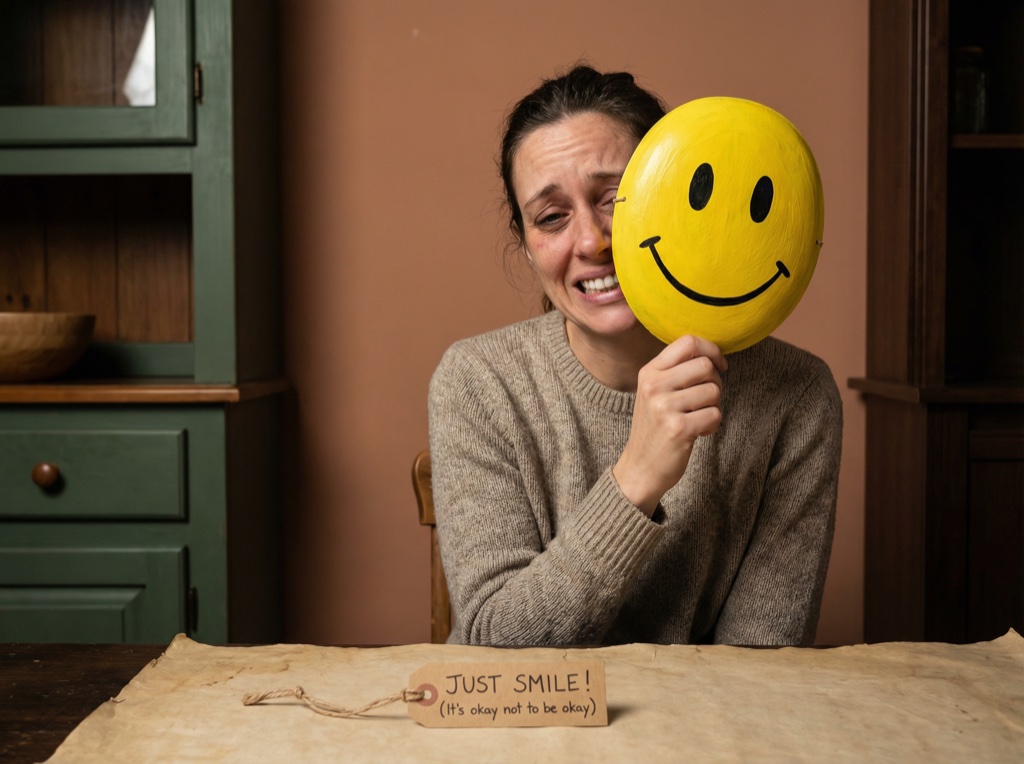
When Good Intentions Turn Into Pressure: What Toxic Optimism Is
In the modern world, there is an unspoken cult of happiness. Social networks are overflowing with smiling faces, motivational quotes, and calls to always think positively, no matter what. It seems that being sad, disappointed, or tired is almost a crime against society. It is from this cult that the phenomenon psychologists call toxic optimism (or toxic positivity) arises. This is a state when a person or their environment tries to artificially maintain a joyful mood, completely denying, ignoring, or devaluing any negative emotions. At first glance, the desire to think positively looks like an excellent strategy for overcoming difficulties. But the problem arises when this positivity becomes forced. Toxic optimism is not genuine joy; it is a defensive mask that a person wears because they are afraid to face real pain. When you lose your job, go through a breakup, or just have a bad day, and you are told: "Smile, it could be worse!" or "Just don't think about the bad stuff," it doesn't help. It creates an enormous amount of internal pressure. You start to feel guilty not only because you feel bad, but also because you can't quickly "pull yourself together" and become perfectly happy again. Such an approach doesn't solve the problem; it only drives it deep inside, forcing you to remain alone with your pain under a bright, but fake wrapper.
Why the Phrase "Don't Be Upset" Often Works in Reverse
Imagine you severely hit your leg, you are in pain, and someone comes up and says: "Just don't feel the pain, think about something pleasant." Sounds absurd, doesn't it? But this is exactly what we do with our emotions when we use phrases like "don't be upset," "don't take it to heart," or "everything will be fine." These words, even when spoken with the best intentions, have the exact opposite effect. Instead of calming a person, they act as a sort of emotional gag. When we tell someone "don't cry," we subconsciously broadcast the message: "Your feelings are inconvenient for me right now, I don't want to deal with them, so please hide them." A person who is already going through a difficult moment feels that they are not heard and not understood. Their pain is devalued, reduced to the level of a trifle not worth paying attention to. As a result, a feeling of loneliness and isolation is added to the initial sadness or anxiety. Moreover, an attempt to forcibly stop an emotion often makes it even stronger. It's like trying to hold a ball underwater: the harder you press on it, the more forcefully it will jump to the surface as soon as you let go. Therefore, the worst thing you can do for yourself or a loved one in a moment of sadness is to try to immediately "turn off" this emotion using empty positive clichés. True relief comes not when we hide from the pain, but when we allow ourselves to feel and acknowledge it.
The Danger of Suppressed Emotions: What Happens When We Ignore Sadness
Our psyche is a complex and very intelligent system where nothing is superfluous. Every emotion, even the one we consider "negative," serves its important function. Sadness helps us survive a loss and adapt to new conditions. Fear warns of danger. Anger signals a violation of our boundaries. When we, giving in to the influence of toxic positivity, begin to ignore or suppress these feelings, we break the natural mechanism of self-regulation. Suppressed emotions do not disappear anywhere; they do not dissolve into thin air just because we forced ourselves to smile. They settle in our body and subconscious, turning into a ticking time bomb. The consequences of such emotional ignoring can be very serious. On a psychological level, this often leads to chronic anxiety, apathy, emotional burnout, or even depression. A person loses the ability to feel not only sadness but also genuine joy, because it is impossible to selectively "freeze" only a part of your feelings — we either feel everything, or nothing. On a physical level, suppressed stress often manifests as psychosomatic illnesses: constant headaches, sleep problems, muscle tension, and digestive system disorders. Our body literally starts screaming about what we refuse to acknowledge on a conscious level. Therefore, allowing yourself to be sad, cry, or get angry is not a sign of weakness; it is a matter of basic psychological and physical hygiene, necessary for maintaining health.
How to Distinguish Genuine Support From Devaluing Feelings
The line between true empathy and toxic positivity can sometimes be very thin, as in both cases, people usually want to help. But the difference lies in what exactly this help is aimed at: supporting the person, or quickly eliminating an uncomfortable emotion. Genuine support always begins with acknowledging reality. It does not try to sugarcoat the situation or instantly find the pluses in it. When you show true empathy, you symbolically climb down to the person in their dark pit, sit next to them and say: "I see how dark and scary it is for you. I will stay here with you." Phrases of genuine support sound like this: "I'm so sorry you're going through this," "I understand why you are so angry, this really is unfair," "It's normal to feel broken in such a situation," "I'm here if you want to talk, or if you just want to sit in silence." On the other hand, devaluation (toxic positivity) always tries to drag the person out of the pit by force, ignoring their state. These are phrases that start with the word "at least": "Yeah, you got fired, but at least now you have a lot of free time!", "Yeah, you broke up, but at least you'll find someone better!". This also includes comparisons with others: "Don't cry, children in Africa have it much worse." Such words offer no solace; they only induce guilt that the person dares to suffer when "things aren't that bad." By learning to distinguish between these two approaches, you can become a much better friend to your loved ones and learn to protect yourself from those trying to devalue your pain.
Allowing Yourself Not to Be OK: Why It Is the Healthiest Choice
One of the most important skills we can master to preserve our mental health is the ability to give ourselves the legal right not to be "in the norm." We must realize that life is not a continuous line of success and joy. It consists of different periods, and feeling tired, confused, or sad is an absolutely normal part of the human experience. Allowing yourself not to be OK means stopping wasting your remaining energy on creating an illusion of well-being. If you had a terrible day, you have every right to come home, lie on the couch and say: "Today I just don't have the energy to be productive and positive." You have the right to cancel a meeting if you feel emotionally exhausted. You have the right not to search for life lessons in every trouble right this second, but simply give yourself time to grieve. When you take off this burden of obligatory happiness, an amazing thing happens: the tension begins to drop. The paradox is that as soon as you sincerely allow yourself to be sad, this sadness stops being so all-consuming. It simply becomes an emotion that came, that you are experiencing, and that will eventually go away, making room for new feelings. Accepting our vulnerability and imperfection makes us much stronger and more resilient to life's crises than any artificial, forced smile.
Ecological Ways to Support Loved Ones in Difficult Moments
When someone close to us goes through hard times, we often feel helpless. It seems to us that we must immediately find the right words that will solve the problem, or give wise advice that will fix everything. But the truth is that most often, a person in a state of stress or grief doesn't need your advice or solutions. They need your presence and the feeling that they are not alone. Ecological support is the art of being near, without trying to "fix" the other person. The best thing you can do is listen carefully and without interrupting. Don't try to immediately change the topic to something cheerful or tell a story from your own life ("Well, I had it even worse..."). Just listen. Ask directly: "How can I help you right now? Do you need me to just listen, or do you want to hear my opinion?". Often, the best support takes a purely practical, everyday dimension. Instead of an abstract "Reach out if anything," offer specific help: "I cooked dinner, I can bring you a portion," "Let me pick up your kids from school tomorrow so you can rest," "I'm going to the store, what should I buy for you?". Such small but real actions show your care much better than hundreds of motivational quotes. And remember: it's normal not to know what to say. The phrase "I can't even imagine how hard this is for you right now, and I don't know what to say, but I just want you to know that I am here" is one of the most sincere and warmest things a person can hear in a difficult moment.